Smocked Easter Dress Styles for Baby Girls & Boutiques
Quick Answer
A smocked Easter dress is a traditional children’s occasion dress featuring decorative stitches across gathered fabric pleats. Popular styles include bishop dresses with neckline smocking and yoke dresses with embroidered bunnies, eggs, or spring flowers. For boutiques, the right design depends on age, silhouette, fabric, embroidery complexity, and wholesale requirements.
A smocked Easter dress combines decorative hand stitches across gathered fabric with spring colors or seasonal embroidery.
Unlike ordinary surface embroidery, traditional smocking works directly over fabric pleats, creating patterns while controlling fullness.
At K-Embroidery, a wholesale smocked clothing manufacturer, we develop custom children’s garments for boutiques and private-label brands. This guide explains Easter dress styles, manufacturing details, existing products, and wholesale ordering considerations.
1. Which Smocked Easter Dress Styles Are Popular?
Bishop, yoke, and heirloom-inspired dresses offer different silhouettes and embroidery placements.
Bishop Smocked Easter Dress
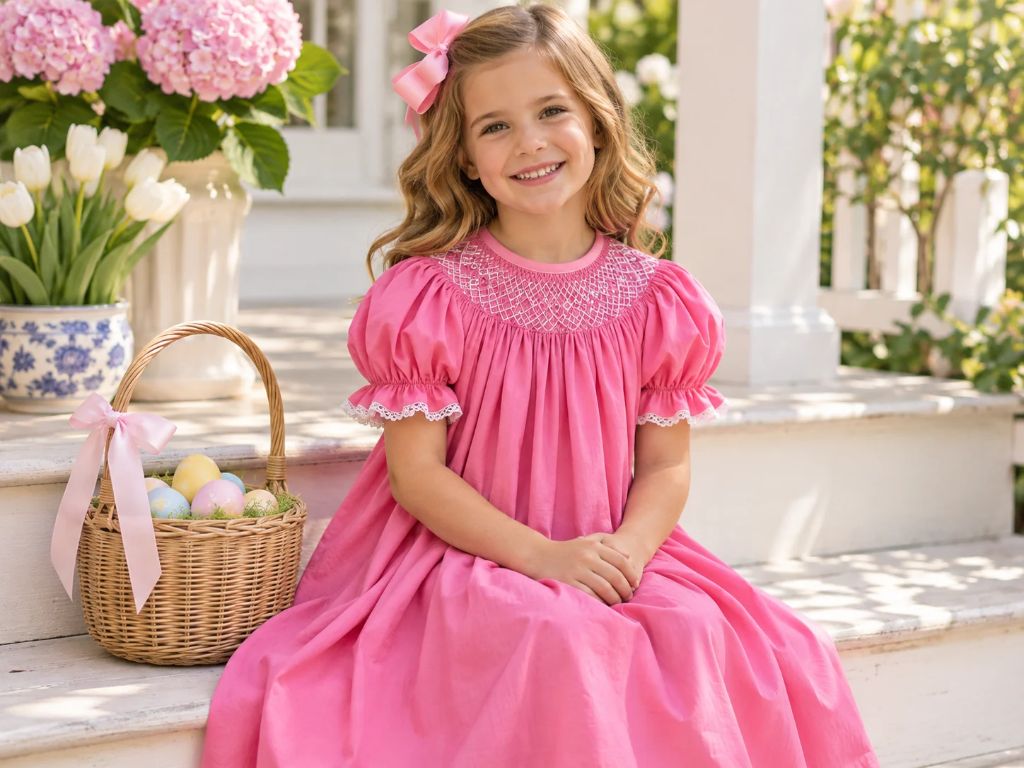
A bishop dress features smocking around a gathered neckline. The stitched pleats hold the neckline shape while the fabric falls freely below.
K-Embroidery’s Smocked Bright Pink Geometric Dress (SG69) combines geometric smocking, cotton fabric, and lace around the neckline and sleeves.
Its published size range covers 3M-9T, making it a reference for boutiques serving babies and older children.
Factory insight: Neckline measurements, smocking depth, and sleeve fullness must be reviewed together. Additional embroidery rows can affect the finished silhouette. For more information about the technique, explore our pillar guide, What Is a Smocked Dress?.
Yoke Smocked Easter Dress
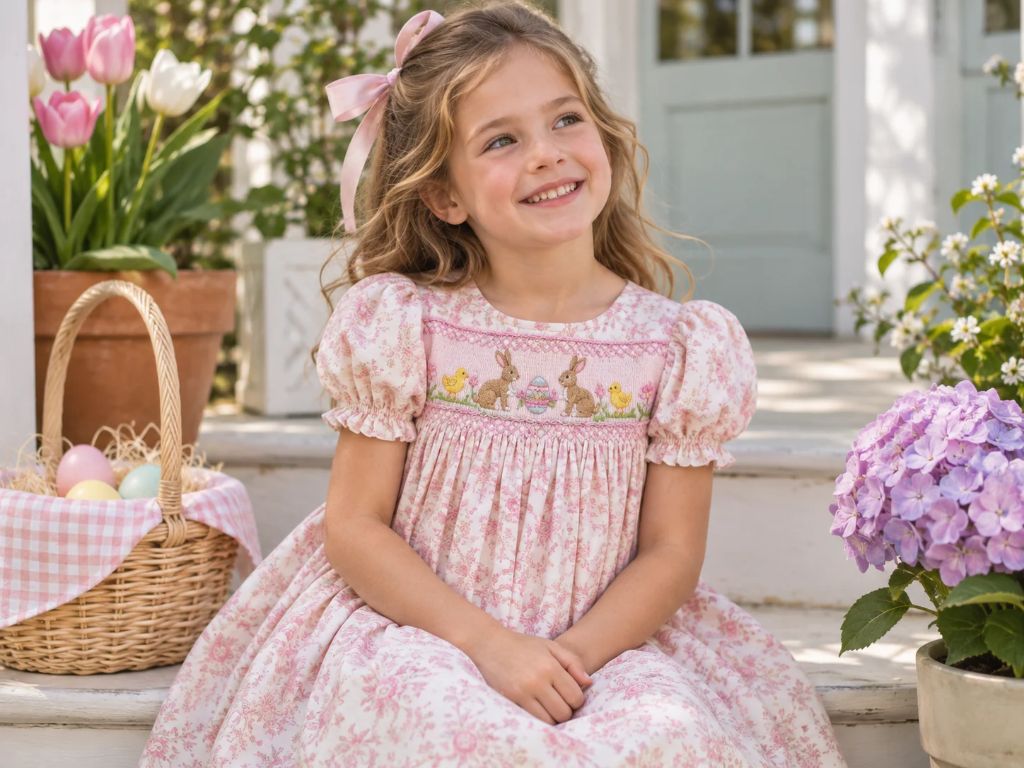
A yoke dress features a defined smocked panel across the chest. This provides space for picture-smocked bunnies, flowers, chicks, or Easter eggs.
The separate panel allows detailed artwork to remain visible against surrounding fabric.
However, the smocked panel must match the bodice pattern and seam dimensions. Larger motifs may require adjustments to the panel rather than additional stitches alone.
Which Dress Style Should You Stock?
| Style | Advantage | Limitation | Suitable customers |
| Bishop smocking | Traditional neckline | Less space for oversized figures | Heirloom boutiques |
| Picture-smocked yoke | Detailed Easter artwork | Panel size restricts motifs | Seasonal collections |
| Geometric smocking | Suitable beyond Easter | Less holiday-specific | Classic clothing buyers |
| Floral heirloom dress | Versatile spring styling | Less recognizable Easter theme | Occasionwear buyers |
Buying recommendation: Choose bunny-smocked yokes when seasonal artwork is the selling feature. Choose bishop dresses when customers prefer classic silhouettes.
2. What Embroidery Makes a Smocked Easter Dress Special?
A smocked Easter dress can feature picture smocking, geometric smocking, or a combination of decorative techniques.
Picture smocking commonly uses stacked cable stitches to create figures across pleated fabric. Geometric smocking uses repeated cable, wave, and trellis patterns.
Why Bunny Count Does Not Determine Embroidery Cost
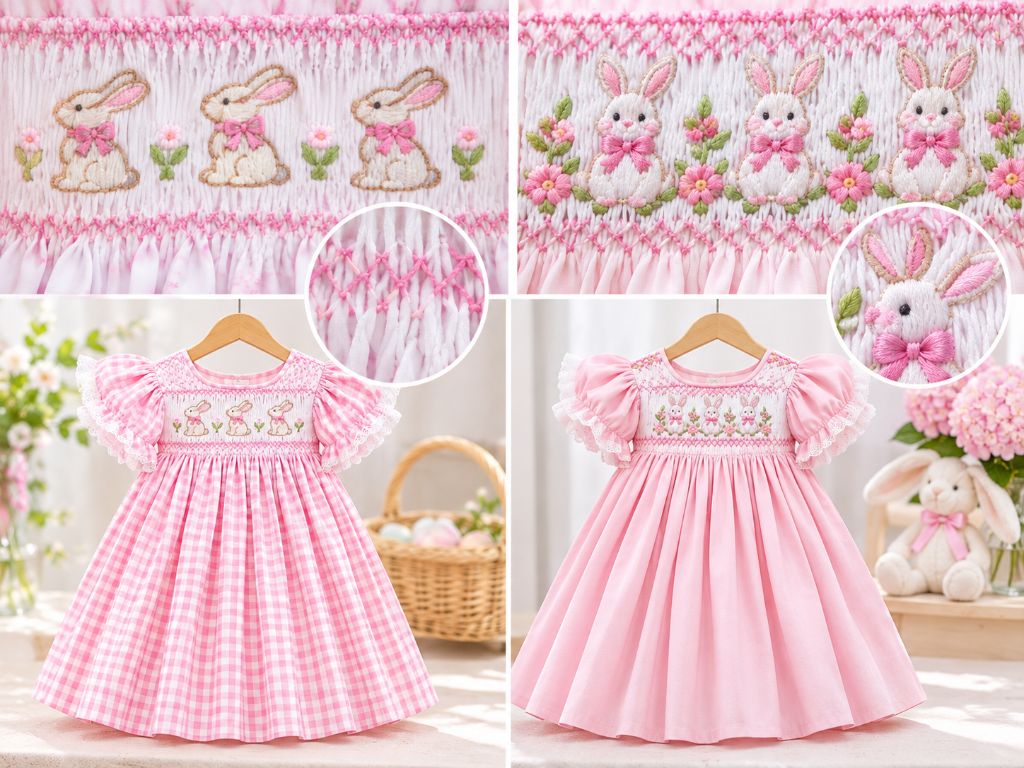
Two smocking plates may each contain three bunnies but require different amounts of handwork.
Production complexity depends on figure dimensions, stitch density, thread coverage, and color placement.
Closely packed stitches across a large figure can require more work than several smaller motifs.
Manufacturer’s Note: Request the actual smocking plate before approving custom bunny embroidery. A reference illustration may not show how the figures fit across the pleats.
Back Smocking and Stitch Tension
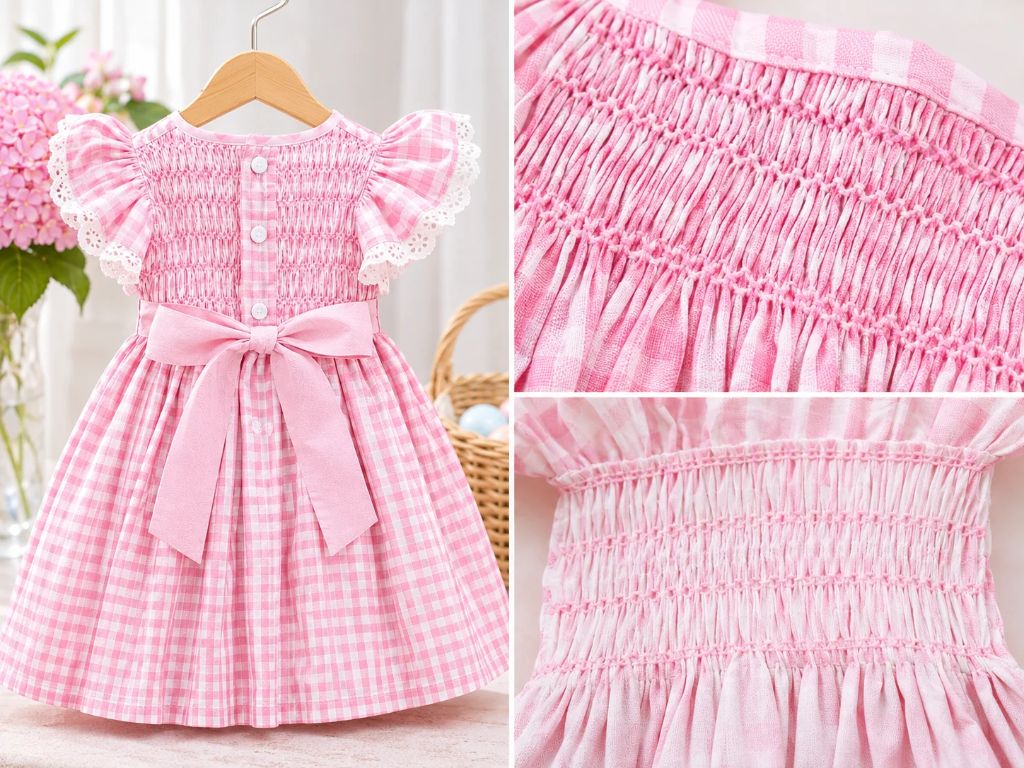
Back smocking consists of supporting stitches on the reverse of pleated fabric.
These stitches help stabilize pleats, particularly around spaces between picture-smocked motifs.
However, the panel must retain suitable flexibility.
More stitches do not automatically improve the garment. Stitch coverage, pleat stability, and thread tension must work together.
When Surface Embroidery Is More Suitable
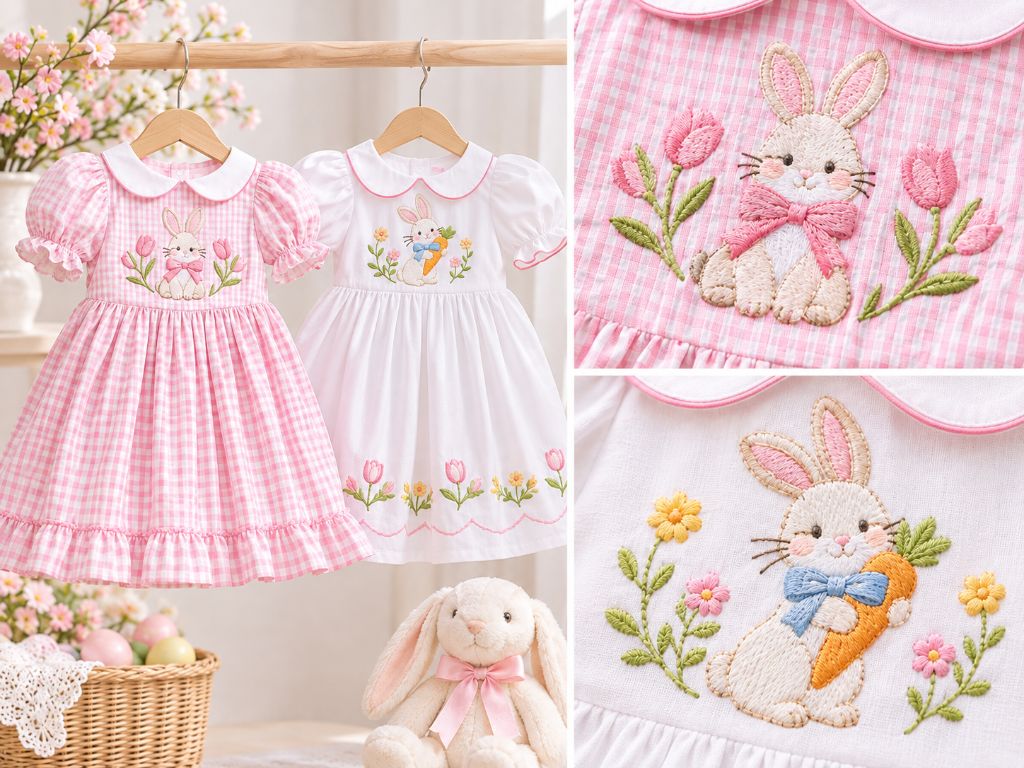
Surface embroidery places artwork on flat fabric without requiring pleated stitches.
This can accommodate larger illustrations or different embroidery placements.
For traditional smocked Easter dresses, picture or geometric smocking remains the defining technique. Surface embroidery offers an alternative for complementary Easter garments.
Which Fabrics Work for Smocked Easter Dresses?
Fabric affects pleat formation, embroidery appearance, garment structure, and comfort.
K-Embroidery commonly uses 110-135 GSM woven cotton poplin for children’s smocked clothing.
Other fabrics may be suitable depending on the design.
| Fabric | Advantage | Limitation |
| Cotton poplin | Defined structure | Finish affects pleating |
| Cotton batiste | Fine, lightweight pleats | May require lining |
| Cotton voile | Soft drape | Check opacity |
| Cotton gingham | Traditional checked appearance | Requires pattern alignment |
Why Pleating Ratio Matters
Traditional smocking preparation often uses an approximate 3:1 fabric-to-finished-width ratio.
For example, 30 cm of flat fabric might produce approximately 10 cm of smocked width.
This is an illustrative starting point, not a guaranteed measurement. Actual results depend on fabric, pleating arrangement, and stitch coverage.
Factory Insight: Matching GSM does not guarantee identical pleating behavior. Changing fabric may require reviewing embroidery thread, panel width, and garment measurements.
Printed Fabrics and Embroidery Placement
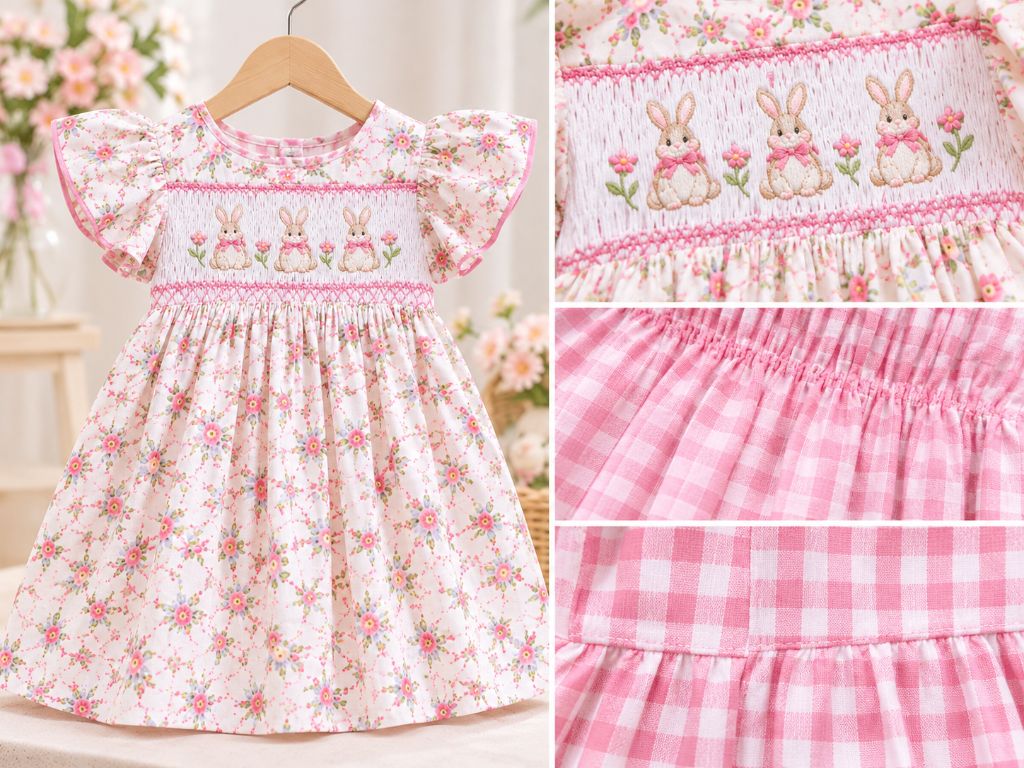
Busy prints can make detailed bunny embroidery harder to distinguish.
A plain smocked panel creates visual separation between the embroidery and surrounding fabric.
Gingham presents another consideration. Its checks become compressed within pleats, while seams require careful pattern alignment.
For custom production, review print scale and embroidery placement together.
K-Embroidery Case Study: Two Easter Designs, Different Constructions
K-Embroidery’s published products illustrate why similar smocking themes do not necessarily mean similar garment specifications.
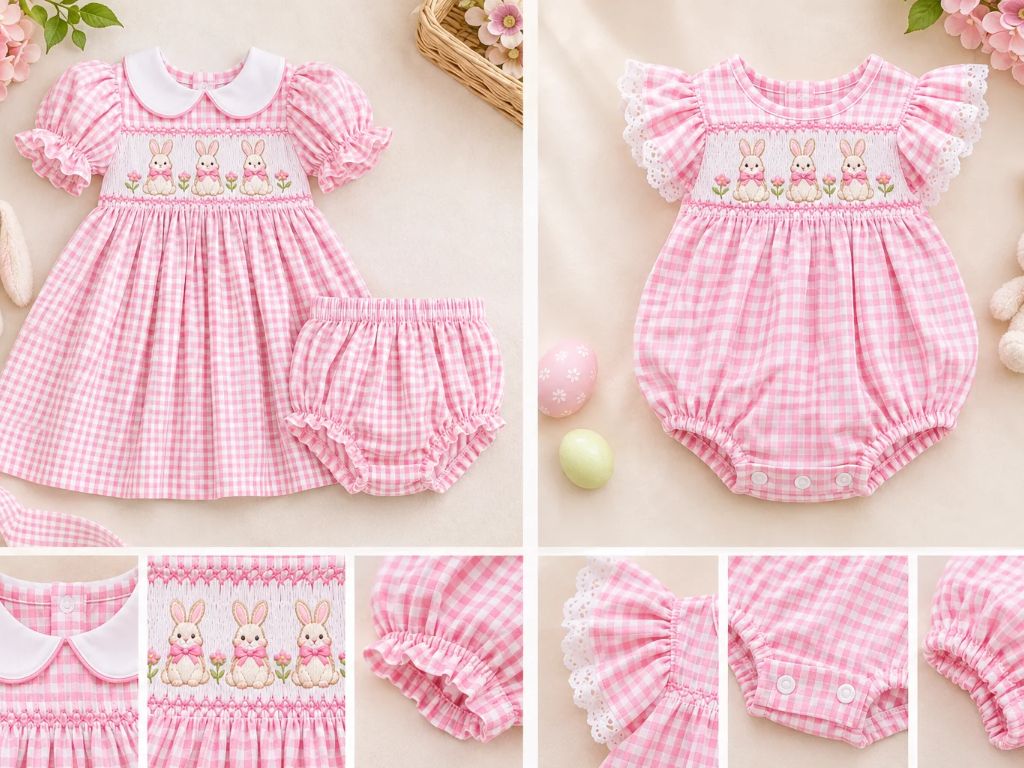
Consider the Somebunny’s Sweetheart Set and Hoppy Little Cutie Bubble.
Both feature three bunny motifs on a white smocked panel. However, their garment structures differ.
Documented Product Comparison
| Feature | Somebunny’s Sweetheart Set | Hoppy Little Cutie Bubble |
| Listed product price | $19 | $18 |
| Main embroidery | Three bunnies in Easter eggs | Three bunnies with bows |
| Main construction | Dress with gathered skirt | One-piece bubble |
| Additional details | Waist bows, separate bloomers | Elastic leg openings, side bows |
| Closure detail | Snaps on bloomers | Three crotch snaps |
| Fabric | Printed woven cotton | Printed woven cotton |
Prices are published product-page listings, not confirmed current custom wholesale quotations.
What This Comparison Reveals
The dress set includes two garments: a dress and matching bloomers. Its construction requires separate pattern pieces, garment assembly, and finishing operations.
The bubble combines a gathered upper section with a rounded lower body, elasticated leg openings, and a crotch closure.
These differences affect cutting and sewing requirements even though both designs feature three embroidered bunnies.
The published prices differ by $1, but this does not establish the reason for the difference. Fabric consumption, labor time, and production margins have not been measured in this comparison.
K-Embroidery Production Insight: Buyers should compare complete garment specifications rather than embroidery motifs alone. Two products with similar smocking may require different sewing operations and material quantities. This case uses documented product information. It does not claim a measured production improvement or a completed factory correction.
How Much Does a Wholesale Smocked Easter Dress Cost?
Wholesale pricing depends on fabric consumption, hand-smocking complexity, garment construction, trims, size range, and order quantity.
For example, the Smocked Bright Pink Geometric Dress (SG69) displays the following prices on its product page:
| Price category | Published amount | Meaning |
| Displayed product price | $25 | Website listing amount |
| Reference FOB price, 0-500 pieces | $15/pc | Published quantity-tier reference |
| Simple sample price | $25/pc | Separate sample-order charge |
These prices serve different purposes and should not be treated as interchangeable.
K-Embroidery’s sample-order instructions state that website prices are not final. Buyers must confirm product prices, shipping costs, and related charges with the sales team.
How Can Boutiques Manage Production Costs?
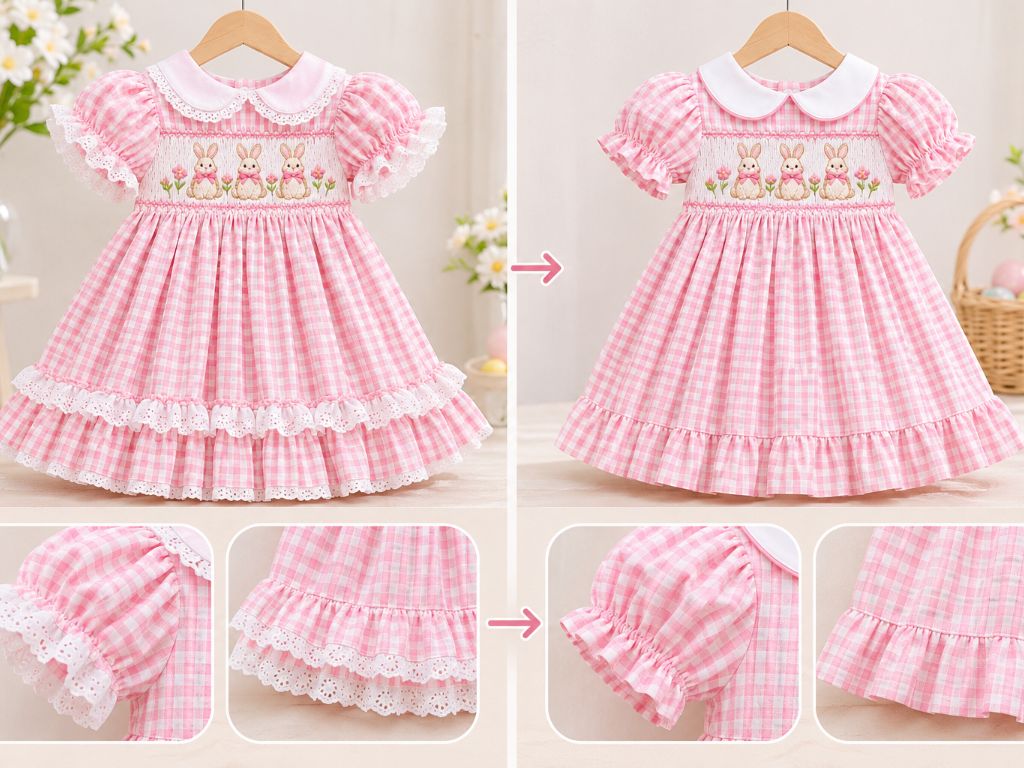
If bunny smocking is the main feature, preserve that artwork while reviewing secondary lace, ruffles, or layered trims.
Simplifying these details may reduce material use or sewing operations, but actual savings require a revised quotation.
Costing recommendation: Compare quotations using the same fabric, smocking plate, sizes, and finishing requirements. Otherwise, a lower price may reflect different specifications.
How to Build a Smocked Easter Dress Collection
A balanced Easter assortment can combine three product roles:
- Statement design: Bunny picture-smocked dress with recognizable Easter artwork.
- Traditional design: Bishop silhouette with geometric smocking and lace.
- Spring carryover: Floral embroidery and subtle colors wearable beyond Easter.
A statement dress can establish the seasonal theme, while floral and geometric styles offer broader styling opportunities.
For baby-focused boutiques, bloomers or matching bubbles can complement the dress selection. Let’s explore K-Embroidery’s Girls’ Easter Collection for additional product references.
What Should Buyers Approve Before Wholesale Production?
Before confirming a custom smocked Easter dress, review these specifications:
| Checkpoint | Required approval |
| Construction | Bishop, yoke, sleeves, skirt fullness |
| Smocking | Motifs, coverage, thread colors |
| Fabric | Composition, GSM, print |
| Sizing | Measurements and panel proportions |
| Finishing | Lace, bows, buttons, lining |
| Production | Sample, MOQ, schedule |
Smaller sizes may require fewer picture-smocking motifs because the available embroidery width changes.
K-Embroidery’s minimum bulk order quantity generally starts at 15 pieces per design, subject to sales confirmation.
Production schedules depend on specifications, approvals, and factory capacity. Buyers should plan backward from their intended Easter retail launch.
K-Embroidery Sample Policy
According to K-Embroidery’s published Sample Policy, boutiques can request samples before placing wholesale orders.
| Sample requirement | Published policy |
| Minimum quantity | 1 piece per design |
| Simple smocked outfit | $25/piece |
| Complicated smocked outfit | $39/piece |
| Production time for 1–10 samples | Approximately 2 weeks |
| Complex designs | May require 3–5 additional days |
Sample production begins after specifications are confirmed and payment is completed.
K-Embroidery shares photographs of completed samples for customer review. Requested adjustments are reviewed before shipment or proceeding with bulk production.
The published policy states that sample costs are deducted from qualifying wholesale invoices for orders exceeding 30 pieces after sampling.
This sample-fee credit condition is separate from the standard bulk MOQ. Buyers should confirm eligibility with the sales team before ordering.
For full details, read the Sample Policy or How to Place a Sample Order.
Order Custom Smocked Easter Dresses From K-Embroidery
K-Embroidery manufactures custom hand-smocked and embroidered children’s clothing for boutiques and private-label brands.
Buyers can discuss bishop or yoke construction, picture smocking, fabric selection, decorative details, and size ranges.
Explore our Girls’ Easter Collection for design references.
To request a quotation, share your preferred smocked Easter dress design, embroidery requirements, fabric specifications, and order quantity.
Frequently Asked Questions About Smocked Easter Dresses
Before selecting a smocked Easter dress for your boutique, these answers can help clarify common design and wholesale questions.
What is the difference between a smocked and embroidered Easter dress?
A smocked Easter dress uses decorative stitches across pleated fabric. A surface-embroidered dress features motifs stitched onto flat fabric. Some garments combine both techniques.
Are bishop smocked dresses suitable for Easter?
Yes. Bishop dresses are used for traditional children’s occasionwear. Pastel colors, floral motifs, and lace can make them suitable for Easter collections.
Can boutiques customize bunny embroidery?
Yes. Buyers can discuss bunny motifs, thread colors, placement, and garment details. Feasibility depends on the smocking plate and panel dimensions.
What is the MOQ for custom smocked Easter dresses?
K-Embroidery’s standard MOQ is generally 15 pieces per design, subject to order confirmation. Size breakdowns and special requirements should be agreed upon before production.
Explore our Easter’s collection and discover your next boutique bestseller!
Get our full Easter collection catalog, FOB pricing, and sample details from a direct Vietnam factory. MOQ from 15 pieces, OEM/ODM welcome.