Smocked Design: Types, Techniques, and Uses in Kidswear
Smocked design is a decorative sewing technique that uses embroidery stitches to hold gathered fabric in place, creating textured patterns and controlled fullness. In traditional English smocking, evenly spaced fabric pleats are secured with hand-worked stitches that provide both decoration and flexibility. Smocked design in kidswear is a garment-detail technique used to shape necklines, yokes, and bodices through stitched pleats.
Smocked design is especially familiar in children’s clothing, from classic bishop dresses to baby bubbles and embroidered rompers. If you have noticed tiny pleats decorated with flowers, animals, or geometric patterns across a child’s outfit, you have probably seen smocking.
But how is it made, and what makes one smocked garment different from another? This guide explains the main techniques, suitable fabrics, production process, and important quality details.
1. What is smocked design?
Smocked design is a form of fabric manipulation and decorative needlework that combines gathering with embroidery. It transforms flat woven fabric into a textured surface while controlling the fullness of a garment. Unlike a printed decoration, smocked design changes the structure of the fabric itself.
Traditional English smocking dates back centuries and was originally used to provide flexibility in practical garments, including rural workwear. Over time, it developed into a decorative technique associated with heirloom sewing, children’s dresses, and handmade clothing.
One important distinction is that traditional hand smocking is not the same as elastic shirring. Hand smocking uses embroidery stitches worked over pleats, while machine shirring typically gathers fabric using elastic thread.
Both techniques can create a gathered appearance, but their construction, surface details, and finishing requirements differ.
2. What are the key features of smocked design?
Smocked design is recognized by its distinctive fabric structure, decorative stitching, and careful handwork. The main features of smocked design are explained below.
2.1. Fabric pleating and gathering
Pleating forms the foundation of traditional English smocking. Parallel rows of gathering threads bring the fabric together into small, regular folds.
The spacing and distribution of these pleats influence the finished panel’s symmetry, texture, and width. With smocked design, uneven pleating can shift motifs away from the centre of a bodice.
2.2. Decorative embroidery stitches
Once the fabric is pleated, embroidery stitches secure the folds and create visible patterns.
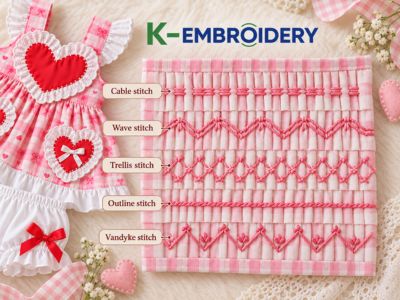
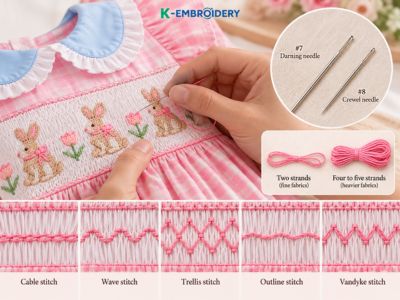
Common smocking stitches include:
- Cable stitch: Forms small horizontal stitches that connect adjacent pleats.
- Wave stitch: Creates flowing, repeated lines across the pleated surface.
- Trellis stitch: Produces diagonal geometric patterns between pleats.
- Outline stitch: Follows a line across the pleats to create a raised decorative effect.
- Vandyke stitch: Creates a distinctive zigzag-style geometric pattern.
These stitches can be combined to form simple bands, diamonds, waves, or more elaborate designs. The embroidery pattern affects how much the smocked design can expand.
2.3. Flexibility and textured appearance
Traditional geometric smocking allows the gathered panel to expand and contract within limits. This flexibility comes from the formation of the stitches and the movement of the pleats.
However, not every smocking technique creates the same amount of stretch. Dense picture smocking and some forms of direct smocking can be much less flexible.
2.4. Handcrafted details
Traditional smocked garments often include hand-worked embroidery, contrasting thread colors, and carefully arranged motifs.
The quality of the finished design depends on stitch tension, even pleat distribution, accurate motif placement, and neat finishing.
3. What are the different types of smocked designs?
Smocked design covers several techniques, each producing a different appearance and fabric structure. For children’s clothing, geometric smocking and picture smocking are especially relevant. Both are commonly associated with traditional English smocking.
3.1. Geometric smocking
Geometric smocking uses repeating stitches to create diamonds, zigzags, waves, and other structured patterns. The stitches connect adjacent pleats while retaining some flexibility in the fabric.
It is frequently used on bishop dress necklines, smocked yokes, bodices, and sleeve details. Geometric patterns can also serve as a background for additional decorative embroidery.
3.2. Picture smocking
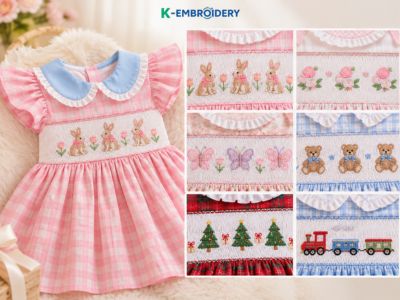
Picture smocking uses closely arranged cable stitches to create recognizable images across the pleated fabric. Popular children’s clothing motifs include:
- Easter bunnies and chicks
- Flowers and butterflies
- Teddy bears and other animals
- Christmas trees and seasonal decorations
- Trains, trucks, and playful characters
Unlike an open geometric pattern, a densely stitched picture motif may require back smocking to help stabilize its shape. This is important because stretching the panel can distort the embroidered picture.
For boutique collections, picture smocking offers opportunities to develop distinctive seasonal or themed designs.
3.3. Honeycomb and diamond smocking patterns
Honeycomb and diamond patterns are recognized by their repeating geometric arrangements.
Honeycomb-style stitching creates a connected, lattice-like texture. Diamond patterns use diagonal stitching to form repeated diamond shapes across the pleats.
Although these terms describe recognizable visual styles, the exact construction can differ between traditional English smocking and other fabric-manipulation techniques.
3.4. Other smocking techniques
Beyond traditional English smocking, direct smocking techniques manipulate and secure fabric folds without always requiring pre-pleating.
Canadian and Italian smocking are examples associated with decorative fabric manipulation. They can create pronounced three-dimensional textures.
These methods may provide limited stretch compared with traditional geometric English smocking.
The following table summarizes the main differences, including trade-offs rather than ranking one method as universally superior.
| Smocking Type | Construction | Flexibility | Typical Application | Advantage | Limitation |
| Geometric English smocking | Embroidery over pre-pleated fabric | Usually flexible | Bishop necklines and yokes | Repeating patterns can accommodate controlled movement | Uneven pleats can disrupt symmetry |
| Picture smocking | Dense, stacked cable stitches form images | Often more restricted | Seasonal chest panels | Recognizable motifs make themes easy to identify | May need back smocking to limit distortion |
| Honeycomb-style smocking | Stitches connect folds in a lattice arrangement | Depends on construction | Decorative bodices | Creates a distinct repeating texture | Spacing errors are highly visible |
| Canadian smocking | Fabric gathered at marked points | Usually limited | Sculptural panels | Creates pronounced three-dimensional shapes | Consumes fabric and may add bulk |
| Italian smocking | Folds formed through direct stitch sequences | Varies by technique | Textural panels | Offers surface effects without conventional pre-pleating | Requires careful marking and stitch sequence |
The right approach depends on whether the smocked design prioritizes flexibility, detailed embroidery, or a sculptural texture.
4. How is smocked design created?
Traditional English smocking combines fabric preparation, pleating, hand embroidery, and garment finishing. Each stage can change the dimensions of a smocked design.
Step 1: Preparing the fabric
The process begins with selecting a suitable woven fabric, such as cotton lawn, batiste, or lightweight cotton.
A common preparation guideline is to allow approximately three times the intended finished panel width. Some pleater instructions recommend a starting ratio of three to four times, depending on fabric weight and construction.
For example, a panel intended to finish at 10 cm wide might initially use approximately 30 cm of fabric. The final cutting dimensions must still be checked against the pattern and sample.
Step 2: Pleating the fabric
The fabric is gathered into evenly spaced folds, either by hand or with a specialized pleating machine.
For machine pleating, the Pleaters International guide describes a normal setup with needle spacing of 10 mm and up to 24 needles in place for the relevant working width. Machine setup varies by model, so follow the equipment instructions rather than treating these figures as fixed garment specifications.
A pleating machine can help prepare consistent rows, but the embroidery itself is still worked by hand in traditional hand smocking.
Step 3: Applying Smocking Stitches
The artisan works decorative stitches across the pleats, following the selected geometric or picture-smocking pattern. Thread and needle selection depend on the fabric.
For example, Smocking Arts Guild of America training material recommends a #7 darning needle or #8 crewel needle as standard options. It also describes using two strands of embroidery floss for some fine fabrics and four to five strands for heavier fabrics.
The appropriate combination should be tested on the actual material. A suitable sample confirms how clearly the smocked design reads against the fabric.
Step 4: Finishing and Inspection
After the embroidery is completed, temporary gathering threads are removed where appropriate, and the smocked panel is checked for shape and symmetry.
The artisan inspects the embroidery, thread tension, and finished panel dimensions before the garment is assembled or finalized.
Pressing must be handled carefully. Excessive pressure can flatten the raised texture and affect the appearance of the stitches.
5. How is smocked design used in children’s clothing?
Smocked design appears in many traditional and contemporary children’s garments.
Its placement influences both the appearance and construction of an outfit. A smocked design on a neckline behaves differently from a decorative chest insert.
5.1. Smocked dresses and bishop dresses
A bishop dress commonly features smocking around a gathered neckline, with fabric flowing into a loose silhouette. Geometric smocking often works well in this area because it provides decorative structure while allowing some movement. Other dresses use a separate smocked panel across the bodice, sometimes surrounded by puff sleeves, collars, or piping.
5.2. Baby bubbles and rompers
Baby bubbles and rompers may feature smocking across the chest or front yoke. Picture smocking is often used to display animals, flowers, or seasonal illustrations. However, garment comfort also depends on the overall fit, seam construction, fabric softness, and appropriate openings.
5.3. Smocked sets and seasonal collections
Smocked details can also appear on shortalls, jon jons, bloomer sets, and coordinated outfits. For example, a spring boutique collection might feature geometric smocking on everyday cotton pieces and picture smocking on Easter-themed outfits.
These approaches serve different design purposes without requiring the same embroidery complexity across every item. Boutique buyers can use smocked design to create visual variety across a collection.
6. Why is smocked design popular in children’s clothing?
Smocked garments combine traditional decoration with practical clothing construction.
Their appeal comes from several characteristics.
- Distinctive appearance: Small pleats and embroidered motifs create details that printed fabric alone cannot reproduce.
- Controlled fullness: Smocking can shape a neckline, yoke, or bodice while allowing additional fabric below the stitched area.
- Design versatility: A single garment silhouette can support different embroidery patterns, colors, and seasonal themes.
- Traditional styling: Smocked dresses, bubbles, and heirloom-inspired outfits remain recognizable styles in classic children’s clothing.
However, smocking alone does not guarantee comfort, durability, or a good fit.
Those qualities also depend on fabric selection, sizing, construction, finishing, and how the garment is used. Smocked design is one part of the garment, not a substitute for good patternmaking.
7. What fabrics work best for smocked design?
Fabric selection affects pleat definition, embroidery appearance, drape, and production consistency. Testing fabric is therefore important before repeating a smocked design across sizes.
| Fabric | Main Characteristics | Suitable Uses | Limitations |
| Cotton lawn | Lightweight, smooth, fine weave | Detailed smocked dresses and blouses | Fine fabric needs careful handling |
| Cotton batiste | Soft, lightweight, delicate | Heirloom-inspired dresses and babywear | May require lining depending on transparency |
| Woven cotton | Available in various weights and weaves | Everyday dresses, bubbles, and rompers | Heavier varieties can produce bulky pleats |
| Linen | Breathable, textured appearance | Natural-style dresses and decorative panels | Wrinkles readily; some weaves create less uniform pleats |
| Cotton voile | Lightweight, airy, soft drape | Summer dresses and decorative layers | Sheer construction may require additional support |
For intricate picture smocking, a stable fabric surface can help maintain the definition of the embroidered motif.
For garments requiring more fullness, drape and fabric weight should be considered alongside the embroidery technique.
Manufacturer’s note: The sample can look right but measure wrong
A smocked design may look balanced while it is still held by temporary gathering threads. That appearance does not prove the panel will match the approved garment measurements after the threads are removed.
Practical factory-check method: Record the panel width at three stages: after pleating, after embroidery, and after temporary gathering threads are removed. Compare the final width with the approved size specification rather than the unfinished pleated width. Check the centre motif position as well as the two panel edges. If the motif shifts or the panel finishes too narrow, investigate pleat distribution and stitch tension before cutting more garments.
For example, if the approved panel width is 10 cm but the embroidered sample measures 9 cm, the discrepancy is 1 cm, or 10% of the target width. This is a hypothetical quality-control example, not K-Embroidery production data. The acceptable tolerance must be agreed for the specific design and size.
Why it matters to a boutique: A smocked design that varies in width can affect the fit and apparent symmetry of the same style across sizes. Ask your supplier to approve a finished, measured sample rather than a photograph of an unfinished embroidery panel.
This is a recommended inspection method grounded in pleating and embroidery quality principles; it is not a claim that every manufacturer uses an identical process.
8. What should boutique owners check when ordering smocked clothing?
When sourcing smocked children’s clothing, buyers should evaluate more than the embroidery motif.
A clear quality checklist can help boutique owners communicate expectations to their manufacturing partners.
- Pleat consistency: Check whether the folds are evenly distributed without unexpected gaps or bunching.
- Embroidery tension: Look for loose stitches, pulling, or puckering that distorts the surface.
- Pattern alignment: Confirm that geometric patterns are symmetrical and picture motifs retain their intended shapes.
- Panel measurements: Compare the finished smocked width with the approved sample and size specifications.
- Fabric suitability: Check whether the fabric supports the required folds, embroidery detail, and garment drape.
- Garment construction: Inspect seams, lining, closures, and finishing around the smocked area.
- Sample consistency: Compare finished pieces against an approved reference before accepting a bulk production run.
For example, a boutique ordering a bishop dress with geometric smocking should pay particular attention to neckline measurements and consistent pleat distribution.
A boutique ordering a seasonal picture-smocked romper may need to focus more closely on motif alignment, embroidery density, and the finished panel shape.
Practical sourcing advice: If a design contains dense picture embroidery, ask the manufacturer to confirm the sample’s measurements after smocking is completed. A visually attractive panel may behave differently from a more flexible geometric-smocked section.
These details matter when producing the same smocked design across different sizes or repeating it for future collections.
9. Top K-embroidery’s smocked design clothing
K-Embroidery is a Vietnam-based children’s clothing manufacturer offering smocked and embroidered designs for boutiques and children’s clothing brands.
Our collections include traditional silhouettes and seasonal styles that buyers can use as references when planning their own assortments.
Here are several designs to explore:
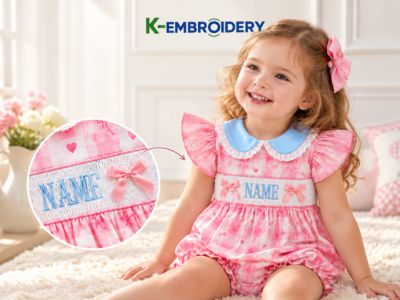
- Blushing Bows Smocked Long Romper: A pink gingham long romper with decorative shoulder bows and a personalized smocked panel.
- Cupid’s Sweetheart Bloomer Set: A Valentine’s-themed outfit featuring heart-inspired smocking details.
- Bunny Blossom Tutu Dress: An Easter-inspired design combining a decorative bodice with a tutu-style skirt.
- Hippity Hop Garden Set: A spring outfit featuring bunny and floral embroidery details.
When planning a collection, consider how the smocking technique, fabric, garment silhouette, and embroidery motifs work together.
A simple geometric smocked design may suit a classic everyday outfit, while detailed picture smocking can develop a seasonal theme. The trade-off is that densely filled motifs may need additional stabilization and closer sample inspection.
10. FAQs about smocked design
Is smocked design the same as embroidery?
Not exactly. Smocking is a specific form of decorative needlework that uses stitches to shape or secure gathered fabric. Other embroidery techniques can decorate a flat surface without gathering it.
Is smocked clothing stretchy?
Traditional geometric English smocking offers some flexibility through the movement of its pleats. However, densely stitched picture smocking and some direct-smocking methods provide less stretch.
Is smocked design always handmade?
Traditional smocking stitches are worked by hand, although fabric pleats can be prepared using a pleating machine. Machine shirring and decorative machine stitching use different construction methods.
Can smocked designs be customized for boutique collections?
Yes. Smocking patterns can be adapted using different embroidery motifs, colors, fabrics, and garment styles. The design should be sampled to confirm its appearance, measurements, and construction before production.
Final Thoughts
Smocked design combines fabric gathering, decorative stitching, and careful garment construction to create distinctive textures and patterns.
Understanding the differences between geometric smocking, picture smocking, and other techniques helps buyers evaluate how a design will look and perform in children’s clothing.
For boutique owners, the most useful approach is to evaluate each smocked design alongside fabric suitability, garment measurements, and production consistency.
Explore K-Embroidery’s children’s clothing collections to discover smocked styles and discuss design options for your boutique.